
GEONAVIGATE / RESOURCES / METAMORPHISM
Metamorphic mineral evidence: isograds and overprints
Use comparable rocks and relative mineral-growth evidence to interpret grade boundaries without losing uncertainty.
Which mineral change actually marks a change in grade?
A mineral list needs a host rock and a history. Index minerals help constrain metamorphic conditions when their associations and the rock’s composition are understood. A quartz-rich rock and an aluminium-rich mudrock need not develop the same minerals under the same conditions. Start with the protolith and observed texture, then interpret grade or facies.
This guide addresses two distinct questions: where an assemblage changes across an exposed area, and whether one sample preserves more than one stage of mineral growth. Neither question can be settled by naming a single green or red grain.
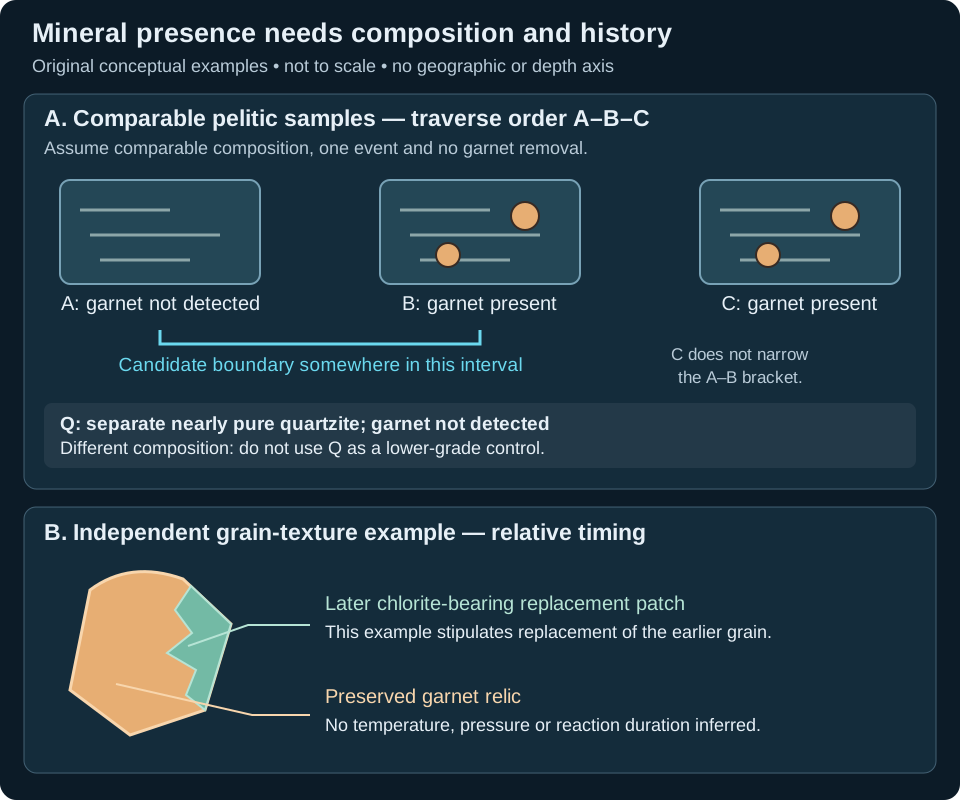
Worked example: bracket an isograd without drawing false precision
Assume A, B and C are fresh, adequately sampled pelitic rocks with comparable bulk composition. Their field order is A–B–C along a traverse. No fault repeats the section in this stipulated example. Their preserved assemblages belong to the same metamorphic event, and garnet has not been removed by later reaction.
- A: mica-bearing pelitic rock; no garnet detected after suitable examination.
- B: comparable pelitic rock containing garnet.
- C: comparable pelitic rock also containing garnet.
- Q: a separate, nearly pure quartzite sample without garnet. Its different composition makes it unsuitable as a garnet-absence control for this comparison.
Under those assumptions, a candidate garnet-in isograd is bracketed between A and B. C supports continuation of the garnet-bearing zone but does not narrow that bracket. The observations do not locate the boundary halfway between A and B, determine a temperature, or define a regional surface. Sample additional comparable exposures and map their positions before extending a line. Show inferred segments as uncertain.
Change one assumption
If A contains a replacement aggregate shaped like an earlier garnet, the original “garnet absent” observation remains true for the present mineral inventory, but it is no longer reliable evidence that garnet never formed. Withdraw the simple garnet-in bracket until the growth and replacement history is resolved. Likewise, a chemical change between A and B can invalidate the comparison even if both rocks look similar in hand specimen.
Separate a preserved mineral from a later overprint
Retrograde metamorphism can partly replace an earlier higher-temperature assemblage. Reaction rates slow during cooling, and the availability of fluid influences which reactions proceed. A surviving older mineral is therefore compatible with some later alteration; complete reversal of all earlier reactions is not required.
The lower sketch stipulates a garnet relic cut by an irregular chlorite-bearing replacement patch. That relative relationship supports later chlorite formation in this hypothetical sample. It does not, by itself, establish a numerical pressure–temperature path or prove that every chlorite grain is late. Verify the replacement texture, the identities of the phases and the wider assemblage. Compare mineral replacement and mineral identification.
Two published cautions for map interpretation
Himmelberg, Brew and Ford (1991) report a metamorphic gradient near Juneau, Alaska, in which peak conditions increase structurally upward. Their USGS abstract describes evidence from mapping, assemblages and mineral thermometry, together with later partial re-equilibration. “Higher grade” therefore need not mean “deeper on the present map.” This is a regional example, not a calibration for another field area.
Kunk and colleagues (2013) interpret compressed isograd spacing in Connecticut in terms of later deformation and a lower-grade overprint. Their study illustrates why present spacing should not automatically be converted into an original geothermal gradient. The linked USGS abstract was checked; these notes do not claim a full-paper review.
A useful observation record
- Keep sample identity, position, host lithology and preparation method with each mineral description.
- Record what was examined and what “not detected” means. An unresolved grain is different from an identified absence.
- Describe inclusions, rims and replacement contacts before assigning an event sequence.
- Separate an observed assemblage, its proposed equilibrium grouping and the confidence of the interpretation.
For drill cuttings, mixing, cavings and loss of orientation can prevent a regional boundary or relative-timing interpretation. Preserve sample-depth provenance and uncertainty. Neither an isograd label nor chlorite abundance supplies a drilling-pressure window, reservoir-quality estimate or unique gamma-ray signature. See the Oilfield Glossary for linked terminology and Chaser Geological wellsite services for geological support.
Worked example: balance a dehydration reaction before interpreting it
A mineral assemblage describes minerals found together; calling it an equilibrium assemblage adds an interpretation. A reaction can explain a change between assemblages, but its equation alone does not establish the mechanism or geological history. The idealized pyrophyllite reaction in Tulane’s metamorphic-reactions notes provides a useful accounting exercise:
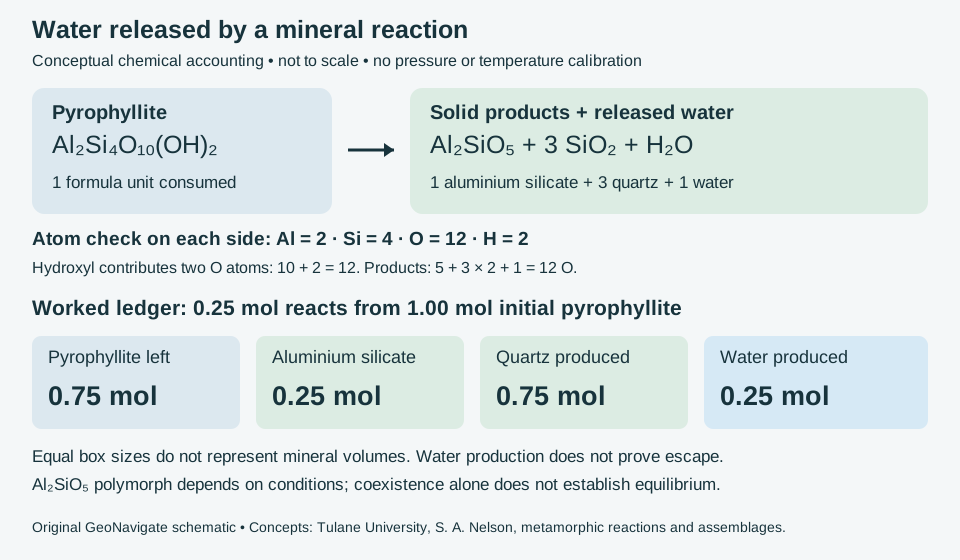
Al₂Si₄O₁₀(OH)₂ → Al₂SiO₅ + 3 SiO₂ + H₂O
Pyrophyllite → aluminium silicate + quartz + water.
The aluminium silicate represents a specified Al₂SiO₅ polymorph, such as kyanite or andalusite, appropriate to the conditions. This teaching calculation does not select one from a numerical pressure–temperature estimate. Count oxygen in the hydroxyl groups as well as in O₁₀: each side contains 2 Al, 4 Si, 12 O and 2 H atoms per reaction unit. The three quartz units supply six of the product oxygen atoms.
Change the amount reacted, not the coefficients
Start with 1.00 mol of pure pyrophyllite and none of the products. Stipulate that only 0.25 mol reacts, with no other reactions or material exchange. The final ledger is 0.75 mol pyrophyllite, 0.25 mol aluminium silicate, 0.75 mol quartz and 0.25 mol water produced. Adding every product coefficient gives 1.25 mol of products, but this is not a mass gain: different formula units contain different numbers and masses of atoms. The residual solid and products together still contain the initial atom inventory.
This dehydration reaction liberates structurally bound water. The ledger says nothing about water escape, reaction time, porosity or grain-volume change. Nor does finding residual reactant beside products prove equilibrium: inspect reaction rims, inclusions and replacement contacts, as discussed in Tulane’s assemblage notes. At a wellsite, a mixed cuttings sample needs provenance and petrographic checks before a mineral list is used to infer one reaction history. Compare the Oilfield Glossary counterpart.
References and illustration credit
- Virginia Tech: Introduction to Earth Science, Metamorphic Rocks — mineral assemblages, protoliths and grade.
- Stephen A. Nelson, Tulane University: Metamorphic Reactions, Isograds, and Reaction Mechanisms — composition-dependent reaction boundaries.
- Stephen A. Nelson, Tulane University: Metamorphic Mineral Assemblages — reaction textures, fluids and retrograde preservation.
- Himmelberg, Brew and Ford (1991), Development of inverted metamorphic isograds in the western metamorphic belt, Juneau, Alaska. DOI: 10.1111/j.1525-1314.1991.tb00512.x. USGS abstract read.
- Kunk, Walsh, Growdon and Wintsch (2013), Telescoping metamorphic isograds. DOI: 10.2475/10.2013.03. USGS indexed abstract checked; direct retrieval unavailable.
Compiled by GeoNavigate from these references, checked 28 October 2026. The worked samples and vector illustration are original conceptual teaching material, not published author figures or measured results. No external expert review is claimed. Browse Geology Guides or contact Chaser Geological.