CHAPTER 01
0:00 — A hole is only useful if you can use it
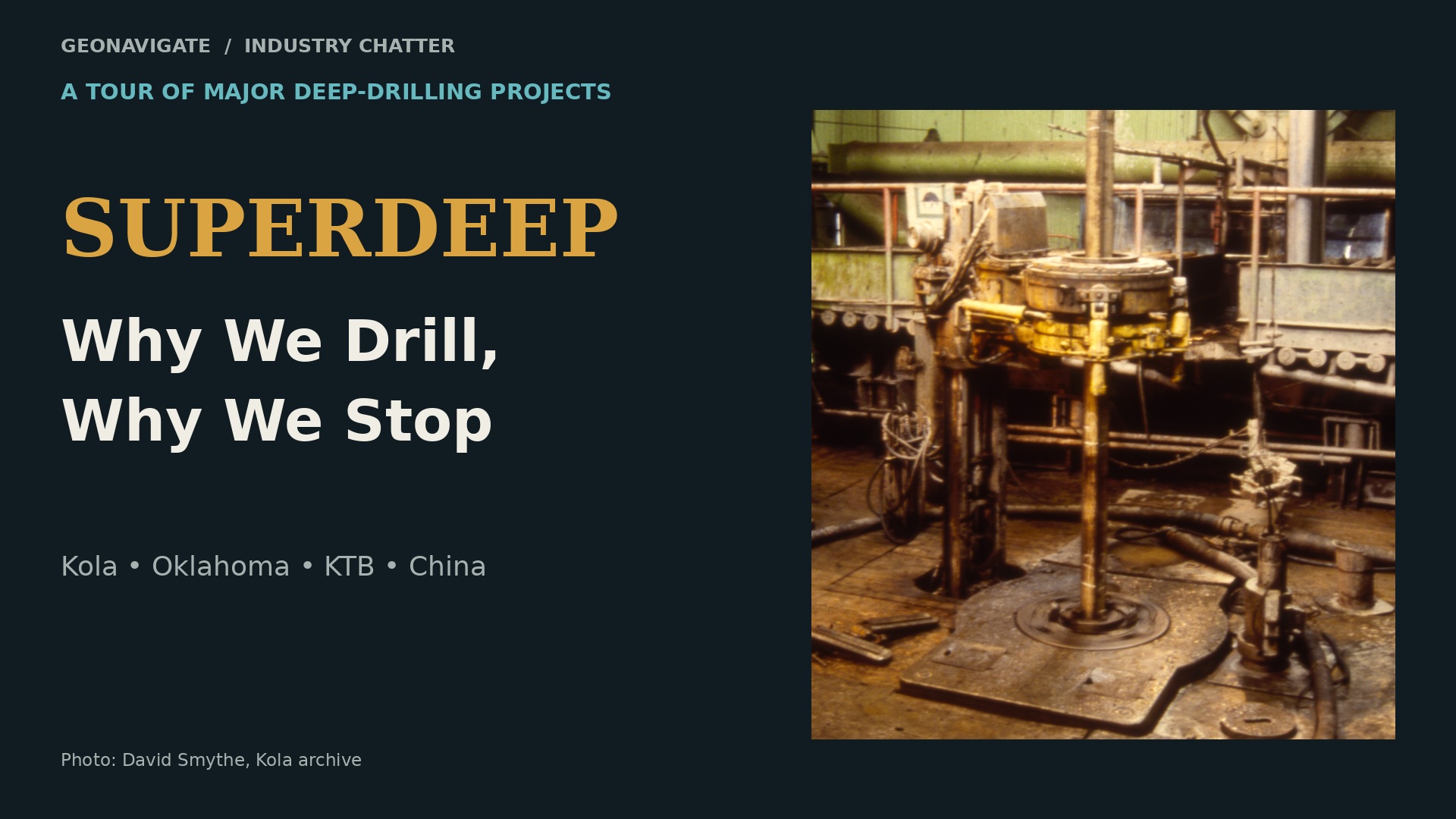
Russia's Kola Peninsula, 1992. Geophysicist David Smythe takes a video camera onto the rig floor of the Kola Superdeep Borehole. Workers handle pipe beneath a forest of steel. Smythe identifies the operation as an attempt to retrieve dropped drill pipe. This is a hole that has already gone more than twelve kilometres into the Earth. And the job in front of the crew is getting equipment back.
That is where the story of superdeep drilling gets interesting. What did people go down there to find? What did the rock actually do? And what finally made the next metre too difficult, too expensive, or no longer necessary? This is a tour of some of the major holes that tested those limits, from scientific experiments to the search for deep gas.
First, one distinction. Measured depth follows the hole, including its bends. Vertical depth measures how far down you have gone. A long well can travel mostly sideways. At sea, the water above the seabed is another separate measurement. We'll keep those quantities separate, and use reported drilling depths without turning them into a misleading league table.
CHAPTER 02
1:13 — Mohole: the ambition beneath the ocean
Before Kola, there was Project Mohole. American researchers wanted to drill through the oceanic crust toward the mantle. The ocean offered a tempting advantage: the crust there is much thinner than beneath the continents. It also put kilometres of moving water between the rig and the rock.
In 1961, a converted drilling barge worked near Guadalupe Island, off Mexico. The deepest test penetrated about a hundred and eighty-three metres beneath the seabed, below roughly three and a half kilometres of water. It recovered basalt. The achievement was learning to drill from a floating platform in deep water, with the much deeper scientific objective still ahead.
Holding position, losing equipment and keeping holes open were difficult. Costs and management became problems too. Congress ended funding in 1966. Mohole never reached its intended boundary. Here, the stopping point was set above ground, before the central geological question could be answered.
CHAPTER 03
2:20 — Kola: the rock changes the question
Kola began in 1970, in the Soviet Union, with an ambitious fifteen-kilometre design. The site put ancient crust within reach of the drill. Researchers wanted physical samples and measurements to test their interpretation of the deep Earth. They also wanted to understand the mineral potential of the nickel-bearing Pechenga region.
The hole passed through a thick volcanic and sedimentary sequence, then into older metamorphic basement below about six point eight kilometres. Gneiss, amphibolite and other crystalline rocks complicated the simple picture inferred from seismic waves. A change in wave speed did not necessarily mark the neat granite-to-basalt boundary that researchers had expected.
That matters because a seismic section is an interpretation. Drilling gives you a sample to test it against. Rock composition, deformation and fluids in fractures can all affect the signal. Kola helped show how much information was hidden inside what had looked like a straightforward boundary. The deeper crust contained a more complicated combination of rocks and fluid-bearing structures.
The engineering assumptions were being tested too. Temperatures rose more than expected. The deeper rock was difficult to keep open, and equipment became stuck or broke. After one major accident in 1984, the researchers' retrospective describes kilometres of drill string left in the hole. Reaching a record once did not mean the crew could simply continue downward from it.
When equipment is lost downhole, drillers call it a fish. They try to catch it with another tool and pull it free. If that fails, they may plug back and steer a new branch around the obstruction. The rig can spend days working without making the well any deeper. A depth record hides all those metres drilled, abandoned and drilled again.
That brings us back to Smythe's camera in 1992, and the attempt to retrieve dropped pipe. Here is David Smythe recalling the operation for BBC Witness History in 2024.
[David Smythe — original BBC Witness History recording, 2024; recalling Kola in 1992]
And before you can do any more drilling, you had to recover that. They were doing what they call a fishing expedition.
Kola's famous reported depth is about twelve point two six kilometres. It stopped short of the fifteen-kilometre design. The account written by Kola researchers places the end of drilling in 1992, amid a drastic loss of funding. Heat, unstable ground and repeated recovery work had made progress difficult; the financial collapse then removed the ability to keep trying.
But the end of deepening was not the end of every investigation. German research records document a Kola hydraulic project funded from 1998 to 2001. The site was later mothballed and its drilling infrastructure dismantled. The end of drilling, the later research and the closure of the working site were separate chapters.
CHAPTER 04
5:29 — Oklahoma: a depth record and a gas well
Now to Oklahoma's Anadarko Basin, where the objective was commercial hydrocarbons. The Baden well passed thirty thousand feet in 1972. Its deep Hunton test did not establish the hoped-for commercial result. Bertha Rogers followed, with the Hunton dolomite again a major target. These were expensive attempts to find a working reservoir beneath a very thick stack of sedimentary rock.
The drilling fluid had a difficult job. It needed enough pressure to hold back deep gas, while other formations could take that fluid away. Unstable shales could fall into the hole. Heat changed the mud's behaviour. The operational account describes constant testing and adjustment. The challenge was managing the whole open hole, not just cutting the rock at the bottom.
In 1974, Bertha Rogers reached a reported total depth of thirty-one thousand, four hundred and forty-one feet: about nine point five eight kilometres. Near the bottom, high pressure and sulfur-bearing fluids complicated the ending. The United States Geological Survey records sulfur crystals coming to the surface after the overpressured well was brought under control.
The deepest rocks did not become Bertha's producing reservoir. Gas production came from the much shallower Atokan granite wash. Baden also had shallower completion work after reaching total depth. Stopping the downward advance could be followed by another phase of the well's life. A depth record, a successful geological test and a productive completion are three different measures of success.
CHAPTER 05
7:11 — KTB: keeping the experiment open
In Bavaria, Germany's Continental Deep Drilling Programme, KTB, returned to the scientific questions. How hot is the crust? How much stress does it carry? Where can fluids move? The site lay in metamorphic rocks shaped by an ancient continental collision. The team drilled a four-kilometre pilot hole before starting the main borehole in 1990.
The pilot supplied core and practical warnings. Steeply tilted rock fabric made a straight hole difficult to maintain. Under stress, parts of the borehole wall broke away. In the main hole, deeper sections also narrowed with time. Researchers identified this convergence as a particularly serious obstacle below about seven and a half kilometres.
Think about the clearance around the drill pipe. It only has to disappear in one troublesome section to trap the assembly. A harder bit cannot solve that. The crew needs a hole that stays open, drilling fluid that works with the formation, and enough room to install protective casing or a liner. Each recovery operation consumes time and money.
At about seven and a half kilometres, temperature exceeded the tolerance of the electronics in KTB's automatic vertical-drilling system. The near-vertical path became harder to maintain. Stuck assemblies and unstable sections forced repeated liners and sidetracks. The contemporary operational account describes the remaining funds running low. In October 1994, deepening ended at a reported nine thousand, one hundred and one metres.
The well recorded more than two hundred and fifty degrees Celsius near its bottom. But saying that heat alone stopped KTB leaves out the failing hole and the budget. A drilling system has many limits. The first one you meet can make the others more expensive to manage.
KTB's afterlife is part of its achievement. The boreholes became a deep laboratory. The cores remained available for new questions, and experiments could examine stresses and fluids in place. Ending the drilling phase preserved a scientific asset. A useful hole can keep producing knowledge long after it stops producing new metres.
CHAPTER 06
9:32 — China: deciding when the next metre is enough
The story continues in China. In the Tarim Basin, Shendi Taqe One combined scientific exploration, oil and gas questions, and a test of deep-drilling equipment. Drilling finished on January fifth, 2025, at a reported ten thousand, nine hundred and ten metres.
The rock was part of the problem. Hard dolomite with chert inclusions damaged the bits. Crews also battled drill-string fatigue, unstable intervals and drilling fluid escaping into the rock. The operator's account says the last nine hundred and ten metres took more than three hundred days. The deepest stretch consumed a disproportionate share of the effort.
Why stop there? The drill had reached ancient Cambrian source rocks. The operator said the required scientific information had been gathered and hydrocarbon shows had been found. Going deeper added risk. The decision was to end deepening and move into testing and further research. A hydrocarbon show still needs testing before anyone can call it a commercial discovery.
A newer research paper reports Xin'an One, in the Junggar Basin, completed in October 2025 at eleven thousand, one hundred and fifty-six metres total depth. It tested deeply buried clastic rocks. Reservoir quality was generally poor, although the team identified more promising intervals and oil and gas shows. The gas analysis pointed to highly mature, coal-derived gas. Testing was still being planned in 2026.
And Shendi Chuanke One, in Sichuan, passed ten thousand metres in October 2025. Its goals include deep petroleum geology and equipment development. By our November 2026 cutoff, that is the latest confirmed milestone in the operator's account. A final depth and outcome have yet to be established in that record. This part of the story remains open.
CHAPTER 07
11:36 — What makes a hole worth drilling?
These projects did not encounter a single universal depth limit. Mohole lost its funding. Kola combined difficult drilling with the loss of financial support. Oklahoma's wells could seek production higher in the section. KTB stopped amid hole instability and dwindling funds, then continued as a laboratory. Taqe's team judged that the next stage should be testing what the well had already reached.
The useful question is what we need from the next metre, whether we can keep the hole usable, and whether the answer is worth the work. This is GeoNavigate Industry Chatter.