
CHAPTER 01
The disappearing lake
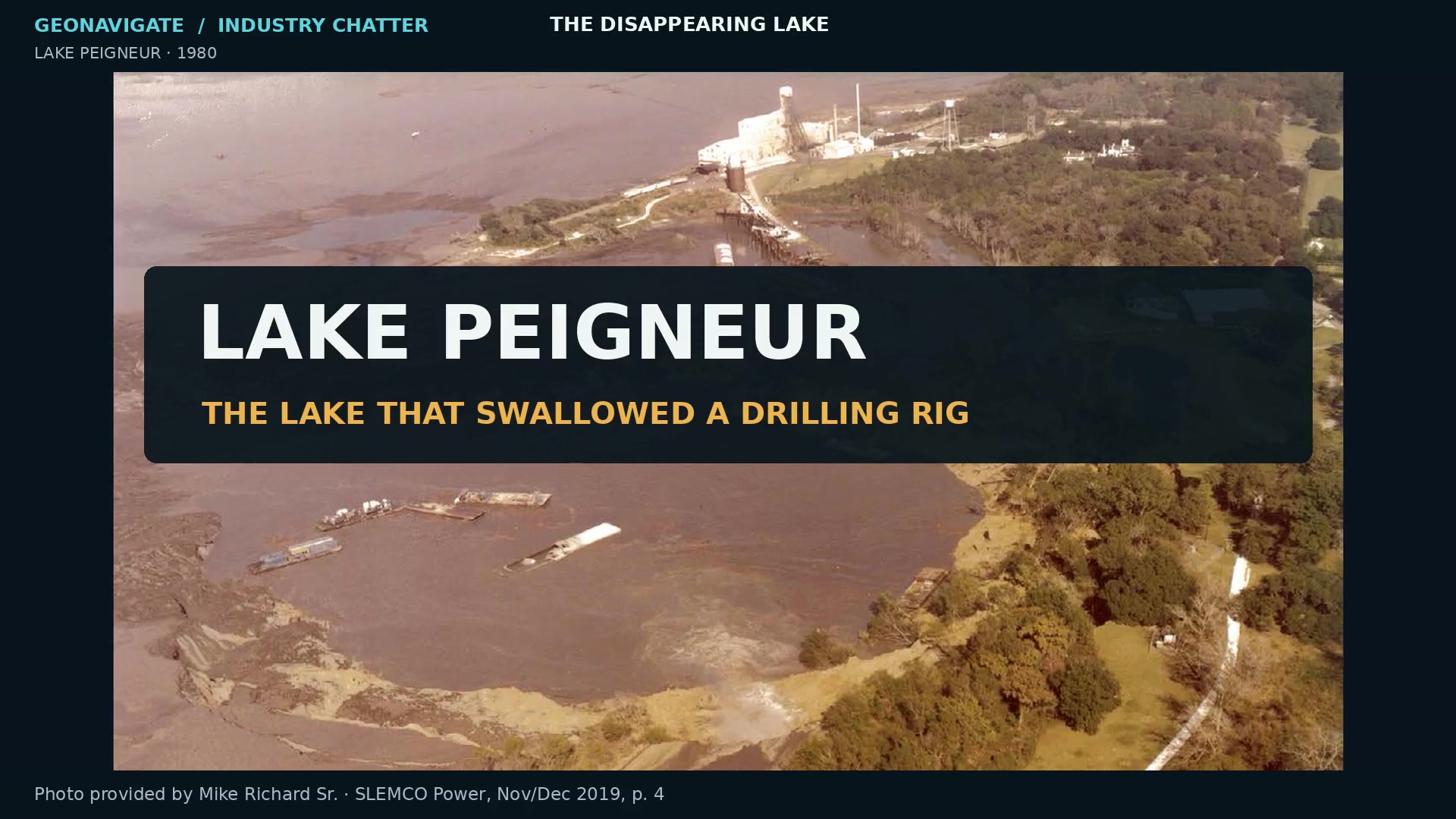
November twentieth, nineteen eighty. Louisiana. A drilling rig disappears into a lake. Barges follow. Trees. Whole pieces of shoreline. But the most terrifying part of this story is happening underground.
Around fifty people are inside the salt mine beneath that lake. An electrician spots muddy water carrying fuel drums through the workings. He flashes the lights three times. The evacuation signal.
Now the landing they normally use is flooding. They need a higher way out. And one man is driving through remote workings, looking for workers who haven't seen the warning. This is Lake Peigneur: The Lake That Swallowed a Drilling Rig.
Mike Richard Sr. — original interview, published 2021: “At one point, the crater was growing away from us, and then it changed direction and started growing toward us.”
CHAPTER 02
Two industries, one piece of ground
Jefferson Island rises above the flat country of southern Louisiana. Under it is a salt dome. Diamond Crystal mines the salt. Out on Lake Peigneur, Wilson Brothers is drilling an exploratory oil well for Texaco. Two businesses. Two sets of workings. One piece of ground.
Salt can bend the surrounding rock and create traps for oil and gas. That attracts drillers. The salt itself attracts miners.
At fifteen hundred feet, the miners worked in rooms with ceilings seventy-five feet high. To get out, they had to reach the shaft.
Above them, a shallow lake. Below them, room after room cut into salt. The separation between those two worlds is everything.
CHAPTER 03
The first warning
The drilling crew runs into trouble. The pipe hangs up. The platform begins to list. The workers leave for shore. Then the rig goes under. Equipment built to work above the water is now vanishing beneath it.
Earlier that morning, underground, master electrician Junius Gaddison hears fuel drums banging. Muddy water is carrying them toward him on the thirteen-hundred-foot level. He warns the others and flashes the power three times: the evacuation signal.
CHAPTER 04
Go higher
Earl Dundas heads down toward the working level. Wilfred Johnson finds the flooding too dangerous at the thirteen-hundred-foot shaft station. The normal phone fails. He uses the refuge chamber's emergency phone and calls for the cage at the thousand-foot level instead.
That changes the escape. Getting to the familiar pickup point is no longer enough. The group has to go higher. Every metre gained on the way to the shaft now has a purpose: keep the people ahead of the water.
Randy La Salle takes a truck into remote areas. He collects four workers who were beyond the lights and missed the signal. A headcount confirms the lower-level group is together. They proceed to the thousand-foot station. The report records the evacuation lifts between eight-forty and nine. Nobody is injured.
The people come up. The mine does not.
Chapter sources1
CHAPTER 05
The boat and the tree
On the lake, fisherman Leonce Viator is out with his nephew, Timmy Dore. Viator later described what he saw.
Leonce Viator Jr. — original interview, date unverified: “When we got further down on the lake, I spotted something, an eye in the ground. To me, it measured a hundred feet in diameter.”
The outboard starts churning mud. With the water dropping, they push toward whatever water remains. They tie the boat to a tree and get ashore. State troopers help them get clear. Viator recalls his boat being pulled into the whirlpool. The tree goes too.
Geologist Whitney Autin later documented the loss of sixty-eight point two acres along the southeastern lake margin. The failures included landslides that worked backward into the shore. So the danger did not stay neatly inside the lake. The edge itself kept failing.
CHAPTER 06
The canal runs backward
Mike Richard watches from a house overlooking the lake and films with a Super-Eight camera. Years later, he describes the shoreline peeling away. The house he is filming from will itself collapse into the water. His footage preserves something almost impossible to explain without seeing it.
The Delcambre Canal connects the lake toward Vermilion Bay and the Gulf. As the lake drains, the direction of flow reverses. Water pours inland toward the collapse. A temporary waterfall forms at the lake, reported at roughly a hundred and fifty feet high.
Water can dissolve salt. Engineers deliberately use that property to create underground storage caverns. But a controlled operation manages where the water goes and how the opening grows. Here, the flooding is uncontrolled. The geometry is changing as the water moves.
The water also displaces air underground. Air and water blow from mine openings on land. What is happening below the lake is forcing its way back to the surface somewhere else. The failure has more than one visible outlet.
And the barges keep disappearing.
CHAPTER 07
What the water gives back
As the lake refilled, nine of the eleven sunken barges came back to the surface.
For the workers, the escape is over. For the people living nearby, the uncertainty continues. Fifteen families have been evacuated. A week later, federal officials tell them the ground is stabilizing, and they are allowed home for Thanksgiving.
And now everybody wants the answer to the question that has been there since the rig went under. How did this happen?
CHAPTER 08
The question under the lake
The famous explanation is that drilling opened the mine to the lake. But the federal investigation could not determine the exact cause, because the flooded workings could not be inspected.
The fight reaches the courts. In nineteen eighty-three, Diamond Crystal accepts thirty-two million dollars from Texaco and Wilson Brothers in an out-of-court settlement. The gardens' interests receive another twelve point eight million from the companies involved. Those are settlements, not a conclusive reconstruction of the underground failure.
The spectacle happened in hours. The argument about responsibility lasts years.
Human lives lost: zero.
CHAPTER 09
The people who made the ending
Diamond Crystal had practiced evacuations. Its company history describes an orderly withdrawal and supervisors coming up on the final trip. Whatever else failed that morning, people knew they had jobs to do for one another.
They had reviewed the evacuation plan just three days earlier.
It is tempting to call an escape like that a miracle and leave it there. But that skips the people who made it possible. The warning. The search. The changed route. The headcount. A whole lake can vanish into the ground and still fail to take a single person with it.
Next: Project Gasbuggy. The American experiment that used a nuclear device to make natural gas flow.