CHAPTER 01
0:00 — A derrick above a secret
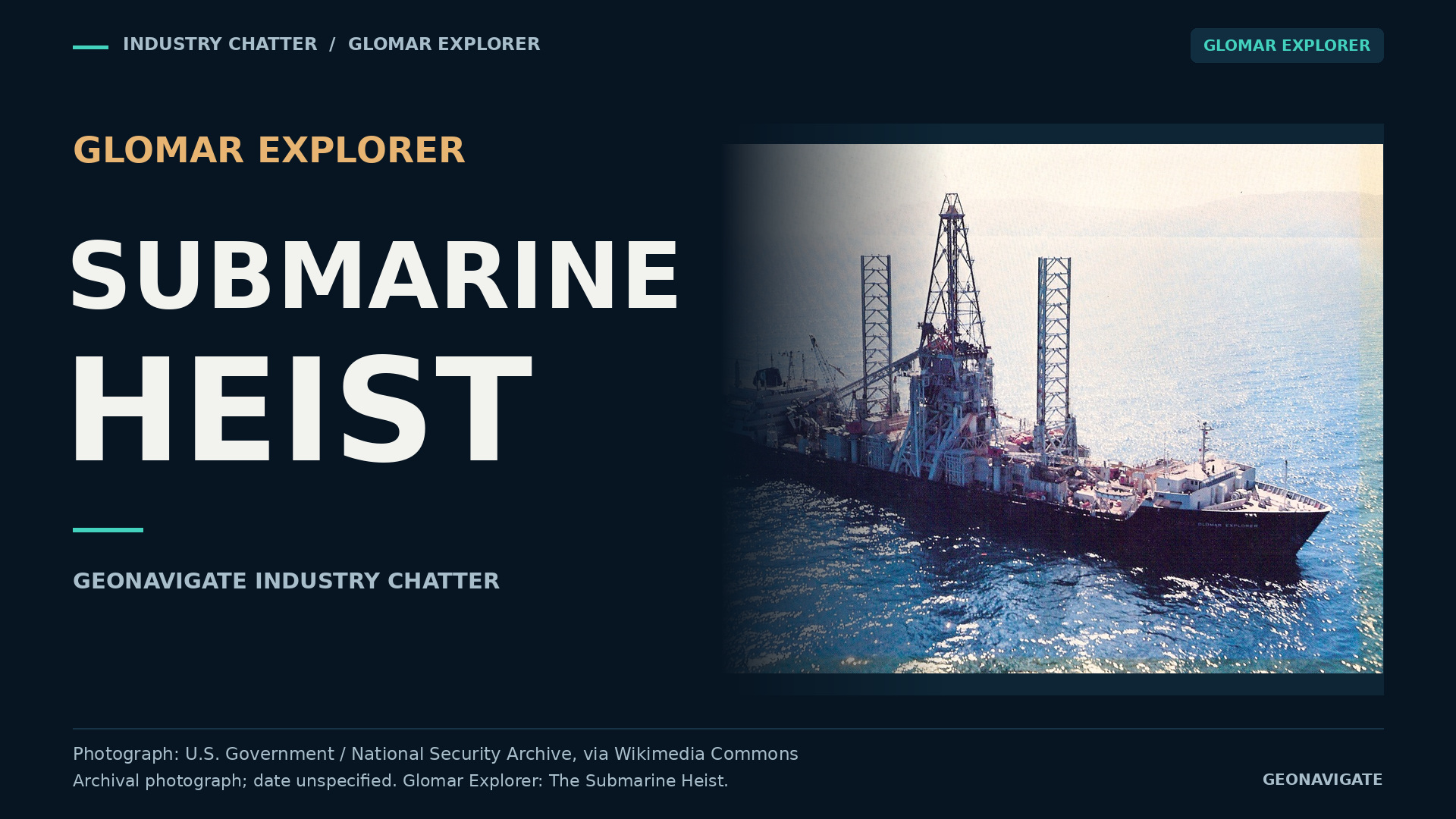
Summer, nineteen seventy-four. In the North Pacific, a ship with a giant derrick holds position over water more than five kilometres deep. Soviet ships have been watching. Below the deck, a string of steel pipe reaches into the darkness. The world thinks Howard Hughes is mining the ocean floor. In secret, this ship is working for the CIA. And the thing it wants to bring home is a Soviet submarine.
This is the Hughes Glomar Explorer. To pull off its mission, the crew has to solve a problem every driller understands. Once you pick up the load, can you keep it? First they have to reach the wreck. Then lift it. Then bring it through the bottom of their own ship, with the ocean moving everything around them.
CHAPTER 02
0:46 — A believable lie
Go back to March, nineteen sixty-eight. The Soviet submarine K-129 disappears in the Pacific. It is a diesel-powered boat carrying nuclear-armed ballistic missiles. Its crew is lost. The Soviet search fails, but the United States locates the wreck. For American intelligence, it is an extraordinary opportunity. Machinery, weapons technology and documents might reveal things that could never be learned from a photograph of a ship in port.
The plan is to recover a major portion of the wreck. There is no existing salvage ship ready to do the job. A purpose-built vessel, a huge underwater capture machine, and years of engineering will be needed. Yet building an enormous ship is hard to hide. So the cover story has to explain the ship, the equipment, and why it will spend weeks almost stationary in the middle of the ocean.
Geology supplies the cover. Manganese nodules lie across parts of the deep ocean floor. These concretions grow slowly as minerals accumulate around a small nucleus, concentrating metals including manganese, nickel, copper and cobalt. They are real deposits with real commercial interest. Howard Hughes lends his name to a supposed mining venture. An unusual ship pursuing unusual mineral wealth sounds plausible. The public can look straight at the derrick and still misunderstand its purpose.
CHAPTER 03
2:15 — Build the load path
The answer beneath that derrick is a giant mechanical claw. It has to reach the wreck, take hold, and lift what remains of a submarine through kilometres of water. The ship is built around a large opening in its hull, a centre well. The load will come up inside the vessel, screened from anyone watching outside. A secret recovery needs a secret entrance.
First, the claw itself has to reach the ship unseen. It travels inside a roofed barge. The barge is deliberately submerged, and Glomar moves above it. The cover opens. Docking legs reach down and lift the capture vehicle into the centre well. Before this ship can secretly recover a submarine, it has to secretly load its own machinery.
This is where the oilfield enters the story. The engineers adapt familiar offshore ideas to an unfamiliar load. Special heavy-lift pipe is handled in sixty-foot doubles. Hydraulic lifting cylinders take the weight as the string is raised or lowered. Seawater pumped through the pipe operates the claw. The string is both a structural connection and part of the hydraulic system.
Now picture that load hanging from a ship in a swell. The ship rolls, pitches, and rises and falls. If those movements are transmitted directly into the suspended machinery, the forces change with every wave. A gimbaled platform allows rotation between the vessel and its lifting equipment. Heave compensation manages the vertical movement. The whole arrangement has to keep an enormous suspended system under control while the surface refuses to stay still.
The ship also has to hold its position. Thrusters respond to its positioning system, working to keep the vessel over the operation below. A long pipe string does not make this a rigid tower from ship to seabed. There are moving bodies at both ends, with a very long connection between them. Station keeping, compensation and lifting have to work together.
Then, during integrated tests off Catalina, the project runs into a wonderfully familiar oilfield problem. The pipe joints will not break out. Zinc-coated threads, red-lead lubricant and seawater have produced galvanic corrosion. The joints seize. The crew needs a giant hydraulic wrench, a different lubricant, and a painstaking clean-up of the threads. A machine built to recover a submarine first has to recover the ability to unscrew its own pipe.
CHAPTER 04
4:49 — The watchers
By May, nineteen seventy-four, the mission proposal reports that system tests and crew training are complete. The weather window is limited, and the schedule has already squeezed the testing programme. This is a decision under uncertainty. The equipment has been tested. The full recovery, at the real depth, on the real wreck, still lies ahead.
Glomar arrives over the site on July fourth. The next weeks bring another complication: Soviet vessels observe the operation. The declassified history records a precaution against an unwanted helicopter landing. Crates are stacked across the landing deck. The crew keeps working. All that machinery has to continue looking like a mining operation, even with curious ships close enough to watch.
During the mission, wires in the heave-compensator position instruments fail. The engineering account records the temporary answer: men with yardsticks and welding-rod pointers, reading positions over headset phones while repairs are made. Think about that contrast in scale. Thousands of tonnes of specialised machinery depend, for a time, on people watching a ruler and passing the numbers along.
CHAPTER 05
6:04 — The load breaks
On August first, the wreck is lifted from the seabed. This is the moment the entire project has been working towards. The claw has reached its target. The lifting system is carrying the load. Now the crew has to reverse the journey, bringing the capture vehicle up as the long pipe string is taken apart above it.
During the ascent, a large part of the target breaks away and falls back to the ocean floor. After years of preparation, the load is being lost on the way up. Some of the wreck remains held. The crew continues with what is left. But getting that portion off the bottom is only the first part of bringing it home.
Even the portion that remains still has to enter the ship. At the surface, waves can move the suspended capture vehicle differently from the vessel above it. Docking legs guide and support that transition into the centre well. That final few metres is its own engineering problem: bringing a massive moving load into a confined opening without losing control.
On August eighth, the recovered portion is secured inside Glomar. Recovery operations finish the next day, and the ship leaves the site. It has achieved something extraordinary, but it has not recovered everything it went down for. Then the story changes scale again. Among what comes up are the remains of six Soviet sailors.
On September fourth, nineteen seventy-four, the sailors are buried at sea in a ceremony aboard the American ship. A recording survives. These are people who died aboard their submarine years earlier, now being honoured by the crew of the ship sent to recover its secrets.
[Original shipboard recording — 4 September 1974; CIA archive; individual speaker identity unverified]
Today we honor these six men, their shipmates, and all men who give their lives in patriotic service.
CHAPTER 06
8:01 — The secret breaks ashore
What secrets came up with the wreck? The public record still leaves part of that answer behind redactions. But the secret memorandum sent to President Ford says the intelligence from the recovered section was significant. Enough, at first, to justify planning another attempt. The people making that decision believed there was still something worth going back for.
A return mission is prepared. Then the cover collapses through events far from the recovery site. Back in June, nineteen seventy-four, before the sea operation, burglars had broken into Howard Hughes's company. The investigation becomes entangled with the secret project. Reporters pursue the connections. The Los Angeles Times publishes an account in February, nineteen seventy-five. In March, Jack Anderson's broadcast exposes the operation nationally.
The next obstacle cannot be fixed with a bigger wrench. The June memorandum to Ford says a Soviet tug has been watching the site since March twenty-eighth. It warns that even another vessel bumping Glomar could damage or disable the recovery system. A second attempt would carry a serious risk of confrontation. Ford approves termination on June sixteenth.
The ship's name becomes attached to a famous official response: neither confirm nor deny. This affair gives the Glomar response its name. The mission ends. The machinery, however, has another life ahead of it.
CHAPTER 07
9:32 — The machinery outlives the secret
For a time, Glomar even works on genuine manganese-nodule tests. Later comes a long period in reserve. Then an offshore drilling contractor sees something useful in the old ship. A major conversion gives it the equipment for a different job. Upgraded in nineteen ninety-eight, the vessel becomes a working deepwater drillship.
This is a real commercial career. Transocean's records place the renamed GSF Explorer in its drilling fleet, with work off Angola and a contract for exploration wells in Indonesia. Its listed drilling water-depth capability is seven thousand eight hundred feet. That rating describes its later drilling configuration. It is a different operation from the original salvage lift through roughly five kilometres of water.
In twenty fifteen, the ship is retired and sold for scrap. An extraordinary hull reaches the end of its working life. But one piece of this story has escaped that ending. To install Glomar's enormous gimbal platform during construction, the shipyard used a floating crane called Sun Eight Hundred. Keep that crane in view.
Jump to Baltimore, twenty twenty-four. After the Francis Scott Key Bridge collapses, a large floating crane helps remove wreckage from the water. Its name is Chesapeake One Thousand. It is the same crane, rebuilt and renamed, that helped assemble the CIA's secret recovery ship more than fifty years earlier.
Glomar's story begins with a question: can you keep the load once you pick it up? In nineteen seventy-four, the answer was only partly. The ship went on to drill offshore wells. The crane that helped build it eventually lifted wreckage in Baltimore. A ship can be scrapped. A secret can be exposed. A good piece of engineering can keep working long after both.