
Skip to content
Chaser Geological

Drilling history / GEONAVIGATE INDUSTRY CHATTER

Gasbuggy: The Nuclear Gas Well

Could a nuclear explosion turn tight rock into a productive gas field? In December 1967, Project Gasbuggy put that idea to the test beneath northern New Mexico. This 8½-minute historical film follows the experiment from core samples and the countdown through re-entry drilling, contaminated gas, an unexpected water leak, and the gap between higher flow and a saleable product. Archival footage, original film audio and engineering reports tell the story of an extraordinary oilfield gamble—and the work that continued after the blast.

Recorded8:33 · measured recordingOriginal narration and archival audio

Prepared

THE ILLUSTRATED EPISODE

Watch the full episode

8:33 · 1080p · English captions

Original AEC and National Archives footage, DOE historical photographs, original countdown audio, and a dated DOE site-manager excerpt. Later site imagery and conceptual diagrams are identified; preservation-copy source markings remain visible. Original narration and archival audio.

THE RECORDING8:33 measured duration

CHAPTER 01

The shot

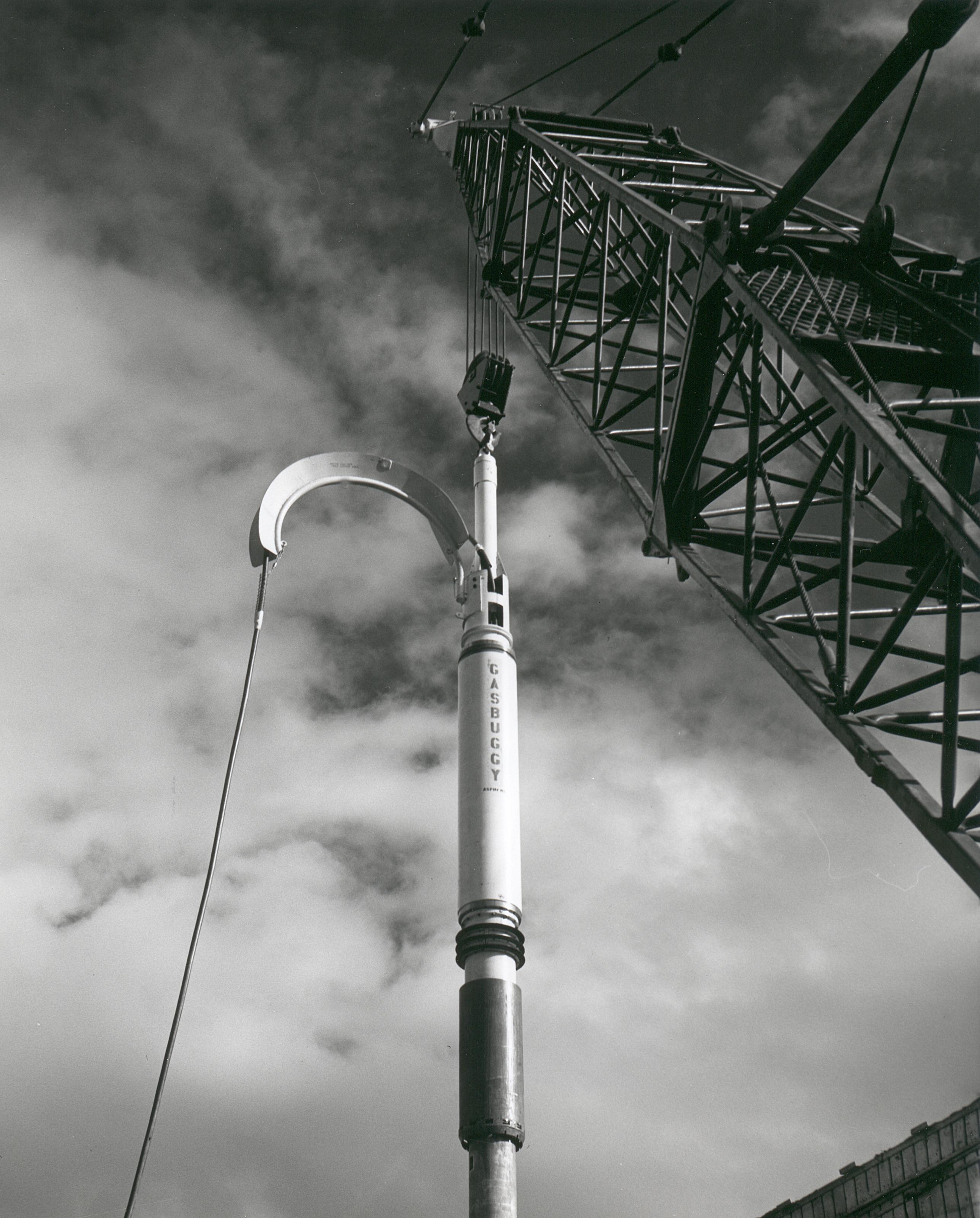
Gasbuggy device suspended beside the drilling rig, circa 1967.
Historical imageThe actual Gasbuggy device alongside its drilling rig, circa 1967.U.S. Department of Energy · HD.8A.012 · Image record ↗

December tenth, nineteen sixty-seven. Twelve thirty in the afternoon. Beneath northern New Mexico, a nuclear explosion tears through the rock. Its job is to make a gas well produce. This is Gasbuggy.

The shot sits roughly one point three kilometres underground, just beneath the gas-bearing Pictured Cliffs sandstone. Above it is a working landscape of wells, roads and forest. Below it, engineers are trying to give trapped gas a new route to the surface.

They will get more gas. What comes up with it will change the meaning of success.

Chapter sources12

CHAPTER 02

The letter

The idea had been around for a decade. In nineteen fifty-seven, El Paso Natural Gas approached Livermore scientists about using nuclear explosives to increase production. The federal Plowshare programme was looking for peaceful uses for nuclear energy. Here was a customer with a very specific problem.

A reservoir can contain plenty of gas and still be a poor well. Gas has to move through connected pore spaces and fractures quickly enough to pay the bills. Tight rock makes that journey difficult. Gasbuggy proposed creating a much larger underground collection zone.

That is the wager. Spend the energy in one enormous pulse, open pathways through the formation, and let the well collect the result. First, somebody has to prove what is already down there.

Chapter sources264

CHAPTER 03

Before the countdown

Two El Paso engineers, Cutler and Kendrick, later described the field work in their drilling report. Crews drilled test wells, recovered core, ran logs and measured gas flow. They tested water-bearing formations too. Those measurements would become the before picture against which the nuclear experiment was judged.

The site was in Carson National Forest, beside the Jicarilla Apache Nation. People used the surrounding landscape. The consequences of a test here would extend beyond the men assembling equipment at the wellhead.

Chapter sources410

CHAPTER 04

The people outside the fence

The health-surveillance team left a remarkable record. Before the shot, it counted people and milk cows within a hundred miles. It located mining and tunnelling operations. Staff collected water, milk and vegetation samples, building a picture of radiation levels before the experiment.

The gas company was watching a reservoir. The monitoring teams were watching a region. Air samplers, field crews and laboratories would have to answer a separate question: did anything escape?

At detonation, thirty-three health-surveillance personnel were on location, including monitoring teams in two aircraft. Their later report recorded no detected release following the shot. That finding concerns the detonation and its surveillance; the later production tests would deliberately bring gas to the surface.

Chapter sources5

CHAPTER 05

The rock becomes the machine

The reported yield was twenty-nine kilotons. Deep below the site, rock was vaporised and melted. A cavity formed. Fractured material above it then collapsed into the opening, leaving a column of broken rock: the nuclear chimney.

The column of broken rock reached upward into the reservoir. Gas could enter the fractures, collect around the rubble and reach a well. The essential test was how much useful reservoir this disturbed zone could actually connect.

The explosion was over. The reservoir experiment was beginning. Crews now had to drill back into a subsurface that had been violently rearranged.

Chapter sources36

CHAPTER 06

Back into the hole

The re-entry record describes voids and broken casing. At one point the drill encountered steel damaged by the shot. Gas samples and pressure tests became clues to the connection between the well and the new chimney. Even that connection was difficult to interpret from the early measurements.

Eventually the gas flowed into production tests. The headline number sounded promising: Livermore reports output six to eight times the earlier rates. But a flow rate is only the first line on a sales sheet.

Chapter sources62

CHAPTER 07

The gas that came back

Laboratory analysis found radioactive constituents in the produced gas, including tritium and krypton eighty-five. Tritium is a radioactive form of hydrogen. Some of it was present in methane molecules. Contamination was mixed into the product the experiment was trying to recover.

The chemical mixture had changed as well. The laboratory report describes carbon dioxide, carbon monoxide and hydrogen diluting the formation gas. Repeated production altered the mixture and reduced measured radioactive concentrations. Gas quality was a moving target through the tests.

A stronger flow therefore raised more questions. How much energy did the gas contain? What was mixed into it? What treatment, handling and acceptance would be required before anyone could buy it? Those questions travel all the way from the wellhead to the customer.

At Livermore, an archive photograph shows JoAnn Rego adjusting a gas-analysis column while Gasbuggy samples are being studied. Her work sits at the other end of that spectacular blast: a sample, an instrument, a result. The fate of the gas depends on what those measurements reveal.

Chapter sources712

CHAPTER 08

Then came the water

There was another oilfield complication. El Paso engineers Dean Power and Charles Bowman reported an unexpected increase in water production. The water contained tritium, so handling it added cost and complexity. Their investigation found that condensation alone could not explain the volumes coming up the well.

They compared chemistry, pressure and flow. Their interpretation pointed to water entering from the Ojo Alamo formation through the well system. Later test results indicated the leak had been sealed. It is a recognisable well problem, made harder by radioactive material in the fluids.

They had detonated a nuclear explosive beneath a gas reservoir, and still ended up chasing a water leak. Every sample and every repair added to the real cost of the experiment.

Chapter sources8

CHAPTER 09

The flare and the pipeline

El Paso’s nineteen seventy-three production report gives the commercial result plainly: the production gas was flared. None had been introduced into pipelines. Federal standards for introducing man-made radioactivity into natural gas had not been established.

The company said the volume involved did not justify the lengthy and expensive process of seeking the necessary federal action. It reported no plan to put the gas into pipelines.

The reservoir had answered one question. The business had several more. Gas at the surface still needed an acceptable product, a route to market and a price that covered the entire operation. Gasbuggy never became that commercial demonstration.

Chapter sources9

CHAPTER 10

What stayed behind

Two further nuclear gas-stimulation experiments followed: Rulison, then Rio Blanco. Livermore’s historical account says the programme demonstrated technical possibilities without demonstrating economic viability. Plowshare ended in nineteen seventy-seven.

At Gasbuggy, surface cleanup was completed, while contamination remained underground in the detonation zone. The Department of Energy reports that sampled nearby producing wells have not shown radionuclides attributable to the test. Subsurface restrictions and long-term oversight remain part of the site’s history.

A Department of Energy site manager explained the distinction in this twenty-twenty film.

Ken Kreie, DOE site manager (original film audio, published 2020): “While there are below-ground restrictions, there are no restrictions for the site surface. The land is open range and used for livestock grazing and recreation.”

Gasbuggy leaves an unforgettable oilfield lesson. You can make the rock give up more gas and still fail to make a sale. In this experiment, the blast was only the beginning of the bill.

Chapter sources2313

THE VISUAL STORY

Episode visuals

Reconstructions and conceptual diagrams are identified in their captions.

THE MOVING IMAGE RECORD

Historical films to explore

Contemporary films, later documentaries and archive records are dated separately. These links open the original sources; reuse status is noted for each.

1968

The Resourceful Atom: Project Gasbuggy ↗

U.S. AEC, The Resourceful Atom (1968). Preservation copy: Periscope Film / Internet Archive. Original countdown audio and historical film excerpts. Existing watermark and timecode retained.

Source attribution is retained in the film and accompanying source notes.

Gasbuggy sequence circa 1967

Air Force Support to the Nuclear Testing Program ↗

U.S. Air Force / National Archives, film 342-USAF-50411, NAID 72228. Gasbuggy site footage, Reel 7, roll 1760.

Source attribution is retained in the film and accompanying source notes.

Circa 1967–1968

Gasbuggy historical photographs ↗

Historical Gasbuggy photographs courtesy of the U.S. Department of Energy; individual source captions identify each image.

Source attribution is retained in the film and accompanying source notes.

Film published 2020; recording date unspecified

Gasbuggy, New Mexico, Site ↗

Ken Kreie, DOE site manager: original audio and imagery from the Office of Legacy Management site film published in 2020. Later site imagery is identified separately from 1967 material.

Source attribution is retained in the film and accompanying source notes.

FOLLOW THE EVIDENCE

Sources & notes

  1. U.S. Geological Survey — Surface Seismic Measurements of Project GASBUGGY Explosion at Intermediate Distance Ranges (1968)

    Shot date/time, precise stratigraphic position, location; early report uses design yield26kt and depth4240ft.

    USGS_1968
  2. Lawrence Livermore National Laboratory — Project Gasbuggy, a plowshare program (2019-12-09)

    1957 proposal; January1967 agreement; international observers;6–8times production; high tritium; later experiments; economics not demonstrated;1977program termination.

    LLNL_HISTORY
  3. U.S. Department of Energy Office of Legacy Management — Gasbuggy, New Mexico, Site Fact Sheet (2026-08 edition)

    29kt;4227ft; shot below Pictured Cliffs; cavity/chimney; five1968–69tests213millioncf; lower heating value; limited fracture reach; contamination remains; sampled nearby wells no test-related radionuclides detected.

    DOE_FACTS
  4. El Paso Natural Gas Company; SPE Fall Meeting1968; OSTI — Drilling and Testing Operations for Project Gasbuggy (1968)

    GB1 and GB2 pretest drilling,coring,logging,water tests,production baseline; subsequent reentry. Full PDF web fetch intermittent; indexed abstract and introduction verified.

    DRILLING_1968
  5. U.S. Public Health Service, Southwestern Radiological Health Laboratory — Report of Off-Site Surveillance for Project Gasbuggy, March1967 to June1968 (1970-02)

    Census people/milk cows100mi; air network35stations;33personnel at detonation including two aircraft; no release detected after detonation in monitored samples. Does not mean no later releases during gas flaring.

    PHS_OFFSITE
  6. Desert Research Institute for U.S. Department of Energy — Radionuclide Migration at the Gasbuggy Underground Nuclear Test Site (2015-08)

    Rubble chimney geometry; reentry beganDec12; broken casing; ambiguous early chimney connection; site-specific transport uncertainties.

    DRI_2015
  7. Lawrence Radiation Laboratory; OSTI — Gas Quality Analysis and Evaluation Program for Project Gasbuggy (1969 data through August)

    Tritium,krypton85,carbon14; tritium-bearing methane; chemical dilution byCO2,CO,H2; testing reduced radionuclide concentrations. Indexed full abstract verified.

    GAS_QUALITY
  8. El Paso Natural Gas Company; OSTI — An Evaluation of Water Production from the Gasbuggy Reentry Well (1969 reporting window)

    Unexpected water hampered operations; tritium-bearing water handling/disposal increased costs; observations exceeded condensation model; attributed to leakage into well from Ojo Alamo; later repair apparently sealed leak.

    WATER_REPORT
  9. El Paso Natural Gas Company; OSTI — Gasbuggy1973 production-test operator report, OSTI4311566 (1973)

    All gas produced to report date flared; no gas pipelined; federal standards for man-made radioactivity in natural gas not established; cost/time of seeking federal action not justified; no future pipeline plan then. Full-title metadata still to verify.

    EPNG_1973
  10. U.S. Department of Energy Office of Legacy Management — Tribal Collaboration — Jicarilla Apache section (current page accessed2026-11-02)

    Site inCarson National Forest borders Jicarilla Apache Nation; surface grazing/recreation restored; nearby gas-well sampling. Older monitoring cadence text differs from later fact sheet; do not narrate cadence.

    DOE_TRIBAL
  11. U.S. Department of Energy Office of Legacy Management — Gasbuggy, New Mexico, Site (current page accessed2026-11-02)

    DOE Legacy Management responsibility from2008; routine inspection,maintenance,records and stakeholder support.

    DOE_SITE
  12. U.S. Department of Energy — Project Gasbuggy photo: JoAnn Rego at Livermore (Circa1968; laterdigitization) DOE_REGO_PHOTO
  13. U.S. Department of Energy, Office of Legacy Management — Gasbuggy, New Mexico, Site — Office of Legacy Management site video (Published2020; recording date unspecified)

    Original25-word surface-access excerpt, nominal source52.35–60.20seconds; dated context, not a new2026 interview.

    DOE_SITE_VIDEO_2020
  14. The Resourceful Atom: Project Gasbuggy

    U.S. AEC, The Resourceful Atom (1968). Preservation copy: Periscope Film / Internet Archive. Original countdown audio and historical film excerpts. Existing watermark and timecode retained.

    ARCHIVE_1
  15. Air Force Support to the Nuclear Testing Program

    U.S. Air Force / National Archives, film 342-USAF-50411, NAID 72228. Gasbuggy site footage, Reel 7, roll 1760.

    ARCHIVE_2
  16. Gasbuggy historical photographs

    Historical Gasbuggy photographs courtesy of the U.S. Department of Energy; individual source captions identify each image.

    ARCHIVE_3
  17. Full film, footage and source credits

    Full shot-by-shot attribution, archival origins and explanatory-graphic notes for this film.

    FILM_CREDITS